We taped Pork Chop again last night and she weighed in at 215 lbs. She is technically ready for slaughter. Everything I've read says you should ship them to the butcher anywhere between 200-300 lbs. Obviously the taping method is a rough estimate, but gives us a good indication she's ready.
The only problem is that we still have no way to get her to the butcher. I started building a crate last night that we plan to put her in for the trip. We haven't yet solved the problem of how to get the crate into the truck bed once she's in. If she weighs 200+ lbs and the crate weighs at least 50 lbs, we'll need at least 4 people to lift it in. We don't have 4 people, so my proposed solution is to attach casters (swiveling wheels) to the bottom of it and roll it up some boards into the truck. I have no idea how well this will work.
Right now the plan is to finish the crate this weekend and take her to the butcher on August 24th. The butcher says I have to make an appointment a week out. We'll report back on how butchering day goes.
Friday, September 14, 2007

Tuesday, September 11, 2007
EGGS!!!

Finally! I never thought I'd be so excited to see an egg in my life. Peeking in that nest box and seeing that beautiful light brown egg sitting there was the highlight of my day yesterday. After 21 weeks of (not so) patient waiting our chickens are finally laying. I only found one yesterday, but I expect the other hens to start soon. They had perfect timing too. Regina was going to pick up a carton of eggs at the store this morning. I'm sure she'll sail by that section with a smile on her face this morning. In 3 weeks we'll have fresh milk in the fridge, fresh butter on toast, fresh eggs for breakfast, fresh pork in the freezer and fresh chicken for dinner. Yum!
Saturday, September 8, 2007
This Week(end)
The weekend is always a busy time at Promised Land. There are always lots of outside projects to be done. It was doubly so this week, because I had the whole week off from work. Here's a general list of what we accomplished this week and weekend:
- Moved new laying hens (4 Americaunas) outside with the meat chickens
- Mowed the north pasture (well most of it)
- Cleaned out milk barn. The calf will be arriving soon, and it needed cleaning for the event.
- Finished outlining sandbox for kids and filled it halfway with sand (more on this later).
- General weeding, fertilizing and watering in the garden
- Killed two chickens and processed the breast meat
- General house cleaning
It's been a busy week.
- Moved new laying hens (4 Americaunas) outside with the meat chickens
- Mowed the north pasture (well most of it)
- Cleaned out milk barn. The calf will be arriving soon, and it needed cleaning for the event.
- Finished outlining sandbox for kids and filled it halfway with sand (more on this later).
- General weeding, fertilizing and watering in the garden
- Killed two chickens and processed the breast meat
- General house cleaning
It's been a busy week.
Thursday, September 6, 2007
You Want A Dairy Cow?!?

That question was asked of us many times before Chloe was purchased. The most recent inquirer was our neighbor out here, who upon learning of our plans, asked if we realized we had to milk it everyday. Our response in the affirmative earned us a "you must be stupid" look.
I'm not sure how our desire to have a dairy cow came about, but I believe Regina mentioned the idea, sort of off hand, to me. We both did a little research to see if anyone really had a "family cow" anymore, and to our surprise we found many articles, two books, and even an online forum just for people who want or own a family cow. Reading all that stuff got us excited. We found ourselves wanting to have fresh raw milk, make fresh butter and cheese, and have a calf to raise every year for beef.
Up until that point we really just wanted to live in the country and have a few chickens. The dairy cow idea was what really got us into homesteading. Most of the magazine articles were from homesteading magazines, and most of the people on the cow forum did homesteading. Of course we started reading all that stuff, and got more interested in self-sufficiency.
Having Chloe has been a joy. We had some rough moments at first (mainly with her and I getting along during milking), but those were soon ironed out, and gained us valuable experience anyway. There are some downsides to having a cow. We don't enjoy as much freedom as we used to. When she's milking twice a day we can't just go out to dinner without planning ahead when we're going to fit in the milking. We can't just pick up and go out of town anymore. That's not a huge deal as we didn't go places much anyway, but it makes planning camping trips harder, which is something we really enjoy.
The pros have so far outweighed the cons for us. We enjoy the fresh dairy, and the feeling of self-sufficiency that our cow provides. I find myself just stopping and admiring her sometimes. There's something so satisfiying to me about seeing our cow graze in our field at sunset. It kind of feels like I'm reconnecting with my roots or some inate desire programmed into man to have and work the land. I get the same feeling when I'm gardening. It's hard to explain. I don't know if we'll have a dairy cow forever, but for now we love it, and wouldn't trade her for the world.
I'm not sure how our desire to have a dairy cow came about, but I believe Regina mentioned the idea, sort of off hand, to me. We both did a little research to see if anyone really had a "family cow" anymore, and to our surprise we found many articles, two books, and even an online forum just for people who want or own a family cow. Reading all that stuff got us excited. We found ourselves wanting to have fresh raw milk, make fresh butter and cheese, and have a calf to raise every year for beef.
Up until that point we really just wanted to live in the country and have a few chickens. The dairy cow idea was what really got us into homesteading. Most of the magazine articles were from homesteading magazines, and most of the people on the cow forum did homesteading. Of course we started reading all that stuff, and got more interested in self-sufficiency.
Having Chloe has been a joy. We had some rough moments at first (mainly with her and I getting along during milking), but those were soon ironed out, and gained us valuable experience anyway. There are some downsides to having a cow. We don't enjoy as much freedom as we used to. When she's milking twice a day we can't just go out to dinner without planning ahead when we're going to fit in the milking. We can't just pick up and go out of town anymore. That's not a huge deal as we didn't go places much anyway, but it makes planning camping trips harder, which is something we really enjoy.
The pros have so far outweighed the cons for us. We enjoy the fresh dairy, and the feeling of self-sufficiency that our cow provides. I find myself just stopping and admiring her sometimes. There's something so satisfiying to me about seeing our cow graze in our field at sunset. It kind of feels like I'm reconnecting with my roots or some inate desire programmed into man to have and work the land. I get the same feeling when I'm gardening. It's hard to explain. I don't know if we'll have a dairy cow forever, but for now we love it, and wouldn't trade her for the world.
Wednesday, September 5, 2007
Sunset on the Homestead
Sunset is a beautiful time of reflection on God's glory and the glory of His creation. Many times in the Bible, we hear about how the beauty and majesty of this world reflect only a small portion of God's beauty and majesty. There is a calmness, stillness, and quiet at sunset in the country that I love. It's one of those times (sunrise being another) when I'll just stop my work outside and stare. I give thanks to the Lord for each of those times, and that life moves slow enough here for us to be able to enjoy the sunset.


Tuesday, September 4, 2007
Book Review
I know that book reviews have little to do with our homestead, unless they're about homesteading. However, I just took up reading again after a long hiatus, and love to share my thoughts on the ones I read. Since Regina has already had her ear talked off about the books I read, and since this is my blog, I'll include a book review every now and then as I finish them. I'm not always reading a book, and with four little ones I don't read much, but I enjoy it, so even 5 minutes here or there is good enough for me.
 I was given this book by a friend at church. He said he's about 90% convinced of the author's point, but still holds some reservations.
The basic premise of the book is that the King James Version of the Bible is the only true word of God, the best translation available, and that the manuscripts that form the basis for all other modern translations (with the exception of the New King James Version) are unreliable. Actually, the author goes beyond calling those manuscripts unreliable to actually assert that there was a conspiracy on the part of those who translated them to change the Bible to fit their views.
In a nutshell, many Christians and Biblical scholars consider the Greek manuscripts that the modern translations come from to better because they are older. The logic is that since they are older they are more reliable because the time between the original writing and the oldest manuscript is less. Less time = less chance they were changed or that there are errors.
For example, take the Gospel of Luke. If Luke wrote his gospel in A.D. 40, and the oldest manuscript (copy) of that gospel was written in A.D. 150, then it would be considered more accurate than a manuscript (copy) of Luke written in A.D.1100. Less chance that there were errors in copying or changes made, right?
The author rejects that in the case of the modern translations. He questions the motives and integrity of the writers of the manuscripts, and the translators who translated them in the late 1800s. He also plays up the authenticity of the newer manuscripts from which the KJV is translated, as well as the Catholic monk who translated them: Erasmus.
I have to admit I never finished this book. I got through about half of it, at which point it got way too in the weeds about translation techniques, and their worthiness. I simply got bored and confused and lost interest. The main thrust of the book is in the first half anyway. I found the whole thing a bit ridiculous. There differences between the KJV and the NIV (as one example) are minimal, and I think if someone wanted to change the Bible through some malicious intent to deny the diety of Christ (as one example) they should have done a better job. My disinterest mounted even more when I found out that there are just as many books out there trying to malign the integrity of the KJV as there are ones trying to malign the integrity of the modern translations.
Frankly, I'm saddened by all this bickering. If we spent as much time helping others and witnessing to the lost as we do arguing amongst ourselves about minutia, we might actually be able to make a difference for Christ. That is one thing I have learned and come to appreciate in our new home church. It is a decidedly non-denominational gathering of Christian brothers and sisters who hold each other up, read and speak the word of God in love, and can disagree on the minutia while still loving each other and witnessing together. We've got former Baptists, Methodists, Catholics, and Church of Christ. Yet we all seem to get along together for the larger purpose of serving Christ. The existance of denominations has always bothered me, and although I believe the Baptists have it 99% right, I will never let that keep me from fellowshiping and serving with other Christians for the glory of God. Jesus said his church was to be a city on a hill, not several hundred different cities scattered about fighting amongst themselves.
My current book is on the Lewis and Clark expedition. I've been bitten by the history bug again, and will report on it when I'm done.
Monday, September 3, 2007
Fall Garden Pics
As you can see, everything is still pretty bare. We hope to show you progress as the season moves along.
 This is Regina's herb bed. We were laughing about how her herb bed here is bigger than her entire garden in Haughton. She said there's no way she could fill the whole thing with herbs, so I think flowers will go here too.
 This is the raised bed I made for Regina from old cinder blocks we didn't need. It gives the bed more form, and holds the good fertilized soil in. It also prevents weeds from encroaching as badly. We didn't have enough blocks to do the whole garden, but did have enough to outline her herb bed and one other. The fence to the left is not the perimeter fence. It is a fence that runs down the middle of the garden and we use it to grow peas and beans. That's right...this is only half of our garden. In fact, this is only one quarter. Behind me is a whole other section as big as this one. I told you it was big.

 These are our pumpkins. Some are pie pumpkins and some jack-o-lantern pumpkins. Regina also planted some more in another area.
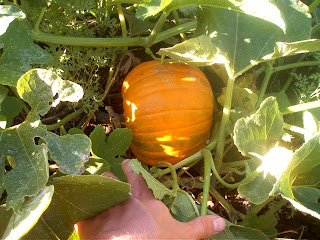 This is the biggest pumpkin we have so far. It is a pie pumpkin and will probably be harvested for Thanksgiving or something.
 This is Regina's herb bed. We were laughing about how her herb bed here is bigger than her entire garden in Haughton. She said there's no way she could fill the whole thing with herbs, so I think flowers will go here too.
 This is the raised bed I made for Regina from old cinder blocks we didn't need. It gives the bed more form, and holds the good fertilized soil in. It also prevents weeds from encroaching as badly. We didn't have enough blocks to do the whole garden, but did have enough to outline her herb bed and one other. The fence to the left is not the perimeter fence. It is a fence that runs down the middle of the garden and we use it to grow peas and beans. That's right...this is only half of our garden. In fact, this is only one quarter. Behind me is a whole other section as big as this one. I told you it was big.
This is part of our corn. This corn is not in neat rows because this is the stuff that sprouted after I tilled the spring harvest under. The rest of the corn is planted in rows. (The flags are there so I don't hit the plants with my lawnmower or tiller. They have reduced "accidents" dramatically)
These are our pumpkins. Some are pie pumpkins and some jack-o-lantern pumpkins. Regina also planted some more in another area.This is the biggest pumpkin we have so far. It is a pie pumpkin and will probably be harvested for Thanksgiving or something.More to come!
Subscribe to:
Posts (Atom)
