Wednesday, September 5, 2007

Sunset on the Homestead

Sunset is a beautiful time of reflection on God's glory and the glory of His creation. Many times in the Bible, we hear about how the beauty and majesty of this world reflect only a small portion of God's beauty and majesty. There is a calmness, stillness, and quiet at sunset in the country that I love. It's one of those times (sunrise being another) when I'll just stop my work outside and stare. I give thanks to the Lord for each of those times, and that life moves slow enough here for us to be able to enjoy the sunset.


Tuesday, September 4, 2007

Book Review

I know that book reviews have little to do with our homestead, unless they're about homesteading. However, I just took up reading again after a long hiatus, and love to share my thoughts on the ones I read. Since Regina has already had her ear talked off about the books I read, and since this is my blog, I'll include a book review every now and then as I finish them. I'm not always reading a book, and with four little ones I don't read much, but I enjoy it, so even 5 minutes here or there is good enough for me.

I was given this book by a friend at church. He said he's about 90% convinced of the author's point, but still holds some reservations.

The basic premise of the book is that the King James Version of the Bible is the only true word of God, the best translation available, and that the manuscripts that form the basis for all other modern translations (with the exception of the New King James Version) are unreliable. Actually, the author goes beyond calling those manuscripts unreliable to actually assert that there was a conspiracy on the part of those who translated them to change the Bible to fit their views.

In a nutshell, many Christians and Biblical scholars consider the Greek manuscripts that the modern translations come from to better because they are older. The logic is that since they are older they are more reliable because the time between the original writing and the oldest manuscript is less. Less time = less chance they were changed or that there are errors.

For example, take the Gospel of Luke. If Luke wrote his gospel in A.D. 40, and the oldest manuscript (copy) of that gospel was written in A.D. 150, then it would be considered more accurate than a manuscript (copy) of Luke written in A.D.1100. Less chance that there were errors in copying or changes made, right?

The author rejects that in the case of the modern translations. He questions the motives and integrity of the writers of the manuscripts, and the translators who translated them in the late 1800s. He also plays up the authenticity of the newer manuscripts from which the KJV is translated, as well as the Catholic monk who translated them: Erasmus.

I have to admit I never finished this book. I got through about half of it, at which point it got way too in the weeds about translation techniques, and their worthiness. I simply got bored and confused and lost interest. The main thrust of the book is in the first half anyway. I found the whole thing a bit ridiculous. There differences between the KJV and the NIV (as one example) are minimal, and I think if someone wanted to change the Bible through some malicious intent to deny the diety of Christ (as one example) they should have done a better job. My disinterest mounted even more when I found out that there are just as many books out there trying to malign the integrity of the KJV as there are ones trying to malign the integrity of the modern translations.

Frankly, I'm saddened by all this bickering. If we spent as much time helping others and witnessing to the lost as we do arguing amongst ourselves about minutia, we might actually be able to make a difference for Christ. That is one thing I have learned and come to appreciate in our new home church. It is a decidedly non-denominational gathering of Christian brothers and sisters who hold each other up, read and speak the word of God in love, and can disagree on the minutia while still loving each other and witnessing together. We've got former Baptists, Methodists, Catholics, and Church of Christ. Yet we all seem to get along together for the larger purpose of serving Christ. The existance of denominations has always bothered me, and although I believe the Baptists have it 99% right, I will never let that keep me from fellowshiping and serving with other Christians for the glory of God. Jesus said his church was to be a city on a hill, not several hundred different cities scattered about fighting amongst themselves.

My current book is on the Lewis and Clark expedition. I've been bitten by the history bug again, and will report on it when I'm done.

Monday, September 3, 2007

Fall Garden Pics

As you can see, everything is still pretty bare. We hope to show you progress as the season moves along.

This is Regina's herb bed. We were laughing about how her herb bed here is bigger than her entire garden in Haughton. She said there's no way she could fill the whole thing with herbs, so I think flowers will go here too.

This is the raised bed I made for Regina from old cinder blocks we didn't need. It gives the bed more form, and holds the good fertilized soil in. It also prevents weeds from encroaching as badly. We didn't have enough blocks to do the whole garden, but did have enough to outline her herb bed and one other. The fence to the left is not the perimeter fence. It is a fence that runs down the middle of the garden and we use it to grow peas and beans. That's right...this is only half of our garden. In fact, this is only one quarter. Behind me is a whole other section as big as this one. I told you it was big.

This is part of our corn. This corn is not in neat rows because this is the stuff that sprouted after I tilled the spring harvest under. The rest of the corn is planted in rows. (The flags are there so I don't hit the plants with my lawnmower or tiller. They have reduced "accidents" dramatically)

These are our pumpkins. Some are pie pumpkins and some jack-o-lantern pumpkins. Regina also planted some more in another area.
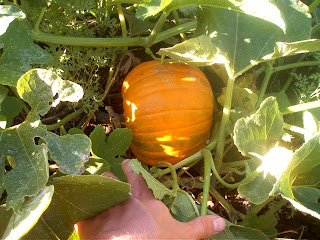
This is the biggest pumpkin we have so far. It is a pie pumpkin and will probably be harvested for Thanksgiving or something.
More to come!


Friday, August 31, 2007

What Can A Pig Teach Us?

This is Pork Chop. She is a 6 month old Bluebutt pig (Yorkshire/Hampshire cross) and is destined for the butcher in about a month. She is our first pig and has taught us a lot about pigs. Firstly, pigs do stink and are dirty, but that's not really their fault. They're made to want to wallow in mud. Pigs, like most animals, don't care where they go to the bathroom. They don't go where they sleep, but will go in their wallow, and then wallow in it. So a wallow is not just mud, and subsequently they stink, as do the pigs that wallow in them.

Pig's don't just wallow in the mud to get dirty. They do it to keep cool. It's simply in their nature. They were born that way.

There's an allusion to people here that Peter made in 2 Peter 2:22:

"Of them the proverbs are true: 'A dog returns to its vomit,' and, 'A sow that is washed goes back to her wallowing in the mud.'"

Pigs are born with a nature that makes them want to wallow in mud and excrement, just as man is born with a nature to wallow in sin and depravity. That is why man can not stand against sin without God. He may try to change his habits, but he can not change his nature anymore than a pig can change it's nature. No matter how many times we try to wash her off with water and make her look nice again, her nature is left unchanged, and she runs right back to the wallow to soak.

But like I said earlier, a pig does not get dirty for the sake of getting dirty. She gets dirty to cool her flesh. In the heat of the day, pigs have few options for cooling off, and will get sunburned and bug bitten. Her only chance for relief is to wallow in mud. It gives her pleasure and comfort, but also makes her absolutely filthy.

The comparison is the same. Tempatation causes a person to burn with desire for whatever sin tempts them. It may be a compunction for gossip, a desire for something they don't have (envy and discontent), anger and grumbling, food (gluttony), laziness (sloth), or sex (lust). The only way to cool their flesh is to dive into that sin. It feels good but leaves them filthy and stinky.

The only way to change our nature is to undergo a dramatic change, as dramatic as a pig changing into another animal. We can not make that change ourselves. It requires the power of the Creator, and the sacrifice of a Savior. Only through repentance, forgiveness, and the power of the Holy Spirit in us, can we ever be saved from the sinful nature with which we were born, and begin to desire something else: a closer relationship with God and His righteousness.

Thursday, August 30, 2007

Our Birds


I thought I'd do a little show case on our current flock of birds.

This is Fabio, the head rooster in our flock. He is a Buff Orpington, and looks very distinctive from the other chickens. He is not aggressive, as some roosters tend to be, and is a little selfish. I've read that roosters are supposed to protect their little harem and cluck to his ladies when he finds food so they can run over and eat it. There's no clucking with this guy. If we put something on the ground in front of him, its gone quick. That could be the reason we rarely see him running around with a group of hens. Who wants a selfish jerk to run your harem?

Sergio is our other rooster. He does not stand out as much as Fabio in appearance, but is just different enough for us to be able to pick him out. He is also a buff orpington. As far as we can tell he's second in command. We haven't seen him running around with a harem either. He tries to blend in as just one of the hens.

Fabio recently started crowing quite often. I love that. The two sounds I think make a farm atmosphere are a cow's lowing and a rooster's crowing. It makes me smile.

These are the ducks currently. They are three weeks old and growing nicely. We originally purchased six, but two have died. That surprised us because everything we've read said that ducks are hardier than chickens. We now do not have enough ducks to cook for Thanksgiving and try one before hand. If we lose any more we'll have to buy a small turkey to have enough food. Oh well.


These are the meat chickens at 3 weeks old. Man they're ugly little things. They look like these crazy little mutant birds. Their legs and breasts are HUGE compared to our laying hens. Their feathers are also coming in which makes them pretty ugly looking.
Regina has pretty much said that if the quality of the meat is poor that she will be highly unmotivated to try meat chickens again. Fingers crossed. We'll find out in 5 weeks.


This is the chicken lady and her little chicken protoge feeding the girls. They mob her every evening. It's like on TV where those throngs of fans mob a celebrity.

And yes, that's a baby attached to her front. My wife does the farm chores with a baby attached to her. Hey, remember our tag line here: "A land overflowing with milk and honey"... and children.


Monday, August 27, 2007

Fall Garden

Fall is almost here (its hard to believe) and that means only one thing: gardening. Most people don't bother with a fall garden. The gardening bug bites in spring when you're tired of being inside and want to work outside. By this time of year its hot, the weeds have mostly discouraged your effort, and you just don't feel like it anymore. Not us. Gardening is more than just a hobby around here. We do it to help save money on food, and to feed the family healthy stuff. Things have been at a lull in our garden lately. Besides the constant tilling I've done over the last few weeks trying to reconquer the garden from the weeds, we really haven't done much. It's pretty much been all about watering regularly.

This weekend we planted the last of the fall garden. Here's the tally of what we have growing: peas, green beans, pumpkins, watermelon, corn, tomatoes, various herbs, carrots, lettuce, bell peppers, jalepenos, strawberries, and buckwheat.

What is buckwheat, you might ask? Well, it's a type of wheat you can harvest, but we didn't plant it for food. Buckwheat can be used as a "green manure crop" in beds you don't currently have veggies in. That means you grow it because it is rich in nitrogen, will shade out the whole bed (preventing weeds and lessening water requirements), and will be tilled back into the soil before it goes to seed, so all that good plant matter can be composting in the bed over winter. It is a relatively cheap seed that sprouts quickly and crowds out the weeds. You can also plant bush beans or peas as a "green manure crop". We did in one section. The seeds are more expensive, but you get a harvest out of them, so it's worth it. This is our first time trying a "green manure crop" and we're hoping it works as advertised.

We also added some perennials to our garden. We planted 3 rose bushes for some color and so Regina could harvest rose hips (apparently they're good for you and can be made into a tea). We also planted some cherry bushes. The cherry bushes have done great and are sprouting green foliage already.

One valuable lesson I learned this weekend is to not let your gas-powered tiller run out of oil. I wasted a good hour or more repairing it because I was too stupid to check the oil. On the bright side, I didn't have to take it to a mechanic, and learned a little about how tillers work.

The majority of the work now will be watering and weeding until harvest time.

I will post a few pictures from time to time so you can see our progress.

Friday, August 24, 2007

Is Raw Milk Safe?

The real answer is: it depends.

Here at Promised Land, we drink raw milk. The only time we drink pasturized, store-bought milk is when our cow is dry and we run out of raw. We find raw milk to be incredibly tasty and full of flavor. It is creamy, rich, and full and after drinking it for 3 months, pasturized milk (even whole) just tastes bland and dead. The term "chalk water" comes to mind.

We have all heard
about the dangers of raw milk and the praises of pasturized. In reading an article on the subject, I read one USDA official quoted as saying that feeding your kids raw milk is like giving them a ticking time bomb. What made that comment astounding was that this same official grew up drinking raw milk on a farm and never once got sick. So what's the truth?

Well, like I said before: it depends. If the cow is healthy, milking and processing practices are clean, and it is stored properly, raw milk is perfectly safe. In fact, raw milk is heathlier for you. Did you know there's good bacteria and bad bacteria out there? I ask because there are a lot of people out there that don't know some bacteria are good. We've been sort of brainwashed to fear bacteria, and super-sanitize everything. There are bad bacteria out there that we should guard against, but there's plenty of good bacteria we should appreciate. Our skin is covered with bacteria, both good and bad. The good bacteria actually protect us and keep the bad from taking over. If you were to kill all the good bacteria on your skin, the bad
would have a royal road in, and make you massively sick.

Well, these good bacteria are also present in our guts, and help us break down our food. The good bacteria in raw milk helps boost these good guys in our intestines and make us healthier. Raw milk is also full of good enzymes that are catalysts for all the processes in our cells. Pasturization kills these good bacteria and destroys these enzymes. Pasturized milk is still good for calories and calcium, but that's about it. Raw milk sours when the good and
bad bacteria grows to a high levels. A little souring is good, and makes butter, sour cream, and yogurt taste better. However, when milk is pasturized and all bacteria are killed, only the bad bacteria get back into the milk from the air, and the milk doesn't spoil...it turns rancid.

So if raw milk is so good, why does the government require the milk companies to pasturize it?
Well, the answer goes back to the 1800s. As people began moving off of farms, access to milk began decreasing. Some tried to ship it in from the country, but people got sick because it spoiled due to lack of refrigeration. People then tried setting up milking operations inside the city to get fresh milk to people faster. These were usually small lots in cities where cows were crammed together in unsanitary conditions, and would often develop fatal leg problems from standing on concrete all day. Not to mention, they were fed whatever was available, which was usually moldy grain or garbage from restaurants. Again, people got sick from unsanitary practices. Pasturization and refrigeration solved both these problems by killing all bacteria in the milk and helping it to last longer. Modern milk production and distrubution would not be possible without pasturization, so it's a good thing where needed.

However, if a person has access to raw milk that comes from a healthy cow, and is processed correctly, it is just as safe and even more healthy for you than pasturized. The best way to ensure these things is to raise and milk the cow yourself. Then there's no question. There are still some things to worry about. Brucellosis (undulant fever) is a disease spread by cows infected with brucella bacteria. Brucellosis can infect humans through raw milk and cause fever, sweating, weakness, headaches, and muscle aches. It is temporary, treated with antibiotics, and not fatal. It is also very rare in American dairy cattle. In fact, most states declare themselves brucellosis free. Texas recently lost that designation due to some cattle that got infected from Mexican cattle on the border, but there has not been a widespread outbreak in this state in decades. Cows can only get brucellosis from other cows. (Our cow is by herself in our pasture, and has no other cows around her in adjacent pastures.) Lastly, all dairy cattle are vaccinated for brucellosis annually as a preventitive measure. The risk is negligible. Most people that get sick from raw milk become ill due to common bacteria that get into the milk due to unsanitary milking and processing practices. Most farm families do not become sick, even from slightly spoiled milk because their bodies have built up immunities to the bacteria around the farm.

If you can get raw milk from someone you trust, I highly recommend it. Be prepared to pay a hefty price though. Organic raw milk can cost from $8-$13 per gallon. It is much cheaper to have your own cow. We probably pay the equivilant of what store-bought milk costs when all is said and done, so we get our raw milk at a significant discount. With milk prices heading up, we may actually end up saving money soon.